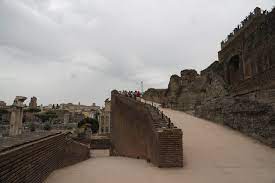
Rome, Italy – In a momentous event for history enthusiasts and tourists alike, the ancient Roman imperial palace, Domus Tiberiana, situated atop Rome’s Palatine Hill, has reopened its doors to the public after nearly half a century of closure for extensive restoration work.
The Domus Tiberiana, dating back almost 2,000 years, once served as the residence for rulers during Rome’s Imperial period. Offering breathtaking panoramic views of the iconic Roman Forum below, this sprawling palace has now become accessible to visitors following years of structural restoration to ensure safety.
Decades of excavation efforts during the restoration unearthed a treasure trove of artifacts, providing insights into the lives of Romans throughout various centuries, particularly after the decline of the Roman Empire.
Alfonsina Russo, the director of the Colosseum Archeological Park, which encompasses the Palatine Hill, described the renovated palazzo as “the power palace par excellence.” She quoted a first-century Roman poet, highlighting the palace’s grandiosity, which seemed “infinite” and equated it to the grandeur of the sky.
While the Domus Tiberiana is named after Emperor Tiberius, who ruled following the reign of Augustus, archaeological studies suggest that the palace’s foundations date back to Nero’s era, shortly after the devastating fire of 64 A.D., which ravaged much of the city.
After the fall of the Roman Empire, the residence endured centuries of abandonment until the 1500s when the Farnese noble family transformed the ruins into an extensive garden.
The reopening of this historic palazzo now allows modern-day visitors to trace the paths once trodden by ancient emperors and their courts on their way to the domus.
The English word “palatial” finds its inspiration in the luxurious imperial residence atop the Palatine Hill, one of Rome’s seven hills.
Situated on the northwest slope of the hill, the domus is recognized as the first genuine imperial palace. Besides housing the emperor, it featured gardens, places of worship, quarters for the Praetorian Guard responsible for protecting the ruler, and a service district for laborers overseeing the Roman Forum.
Archaeologists, with the support of restoration work carried out even during the COVID-19 pandemic when tourism was at a minimum, managed to piece together centuries of history in a place that had somewhat faded from memory.
Visitors to the reopened Domus Tiberiana can explore a curated selection of hundreds of discovered artifacts, including metal and glass objects, statues, decorative items, and ancient coins, shedding light on the rich tapestry of Rome’s past.