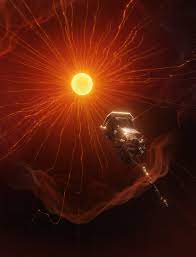
In a groundbreaking achievement, NASA’s Parker Solar Probe (PSP) has become the first human-made spacecraft to navigate through a formidable solar explosion in close proximity to the Sun.
This remarkable feat now enables physicists to conduct an intricate study of solar plasma, as well as gain insights into the early stages, structures, and evolution of Coronal Mass Ejections (CMEs).
Launched in August 2018, the PSP embarked on an unprecedented mission, conducting in-situ (on-site) observations during two consecutive days in response to an interplanetary CME event that occurred in September of the previous year. This daring approach has provided solar physicists with a unique vantage point to observe stellar events and expand their studies, ultimately advancing our understanding of the solar system’s evolution.
Coronal Mass Ejections, or CMEs, are violent eruptions of gaseous matter and magnetic fields expelled from the Sun’s outer atmosphere, known as the corona. These explosive events release billions of tons of plasma at astonishing speeds, ranging from 100 to 3,000 kilometers per second, posing potential threats to celestial bodies, satellites, and spacecraft along their paths.
The Sun, central to our solar system, remains enigmatic in many aspects, despite its pivotal role in sustaining life on Earth. Solar phenomena, such as powerful plasmas, solar flares, and solar winds, can adversely affect our planet, disrupt space weather, and even disrupt satellite-based networks, impairing communication systems.
On September 5, 2022, PSP detected a formidable CME before it entered the scorching solar environment, capturing powerful ejections. The Solar Wind Electrons, Alpha, and Protons (SWEAP) instrument aboard the probe recorded particles accelerating to speeds of up to 1,350 kilometers per second. Additionally, scientists observed bidirectional electrons, low proton temperatures, low plasma beta, and high alpha particle to proton number density ratios.
Designed and constructed by the Johns Hopkins Applied Physics Laboratory (APL), the PSP boasts a cutting-edge heat shield on its front, capable of withstanding extreme temperatures when it ventures closest to the Sun. Meanwhile, the spacecraft’s interior remains at near-room temperature. During its closest approach, PSP ventures within approximately 3.8 million miles of the Sun.
“This CME is the closest ever observed to the Sun. We have never seen an event of this magnitude at this distance,” remarked Nour Raouafi, the project scientist of Parker Solar Probe, in a press release issued by Johns Hopkins APL.
The findings of a recent study, published in The Astrophysical Journal, delve into the probe’s heat shield, radiators, and thermal protection system, underscoring their crucial role in maintaining stable temperatures.
The study’s in-situ polarity data confirmed that solar eruptions affect the global reconfiguration of the Heliospheric Current Sheet (HCS) following a CME event. Consequently, CMEs may play a pivotal role in shaping the evolution of the HCS throughout the solar cycle, offering fresh insights into their influence on the development of young solar wind.
For decades, solar physicists have strived to unravel the forces surrounding the solar surface that trigger these awe-inspiring solar explosions, propelling particles to astonishing speeds and unveiling the mysteries of our Sun.